
Bulleid Light Pacific Locomotives
(West Country and Battle of Britain Class)
A Brief History
These locomotives were introduced in 1945 by the Southern Railway to a design by Oliver Bulleid. They were designed as a smaller version of the Merchant Navy Class. Their 18 ton axle loading and 8 foot 6 inch wide cabs enabled the class to be used almost anywhere on the Southern Region. Later members, 34071 onwards, were built with wider 9 foot cabs. These locomotives were attached to wider 5,500 gallon tenders.
They incorporated the same novel features as the Merchant Navy Class including an all-steel welded boiler, chain-driven valve-gear, inside motion enclosed in an oil bath and 'air-smoothed' casing.
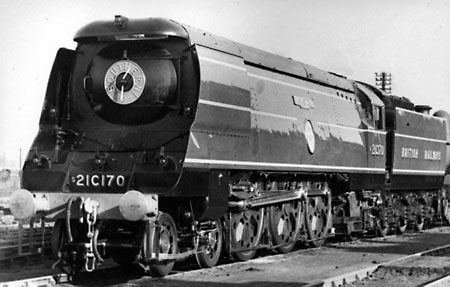 |
s21C170 Manston when new. It carries a Southern roundel on the smokebox, but is lettered British Railways on the tender. This was the last of the 8ft 6in. wide examples |
As designed the class had straight fronted cabs, but from 21C164 (34064) onwards this was changed to a wedge shape to give increased visibility. The earlier locomotives had their cabs changed as they went though the Works.
Originally the class had three safety valves positioned ahead of the dome, but after some incidents of water being discharged through them under braking they were repositioned behind the dome and reduced to two. The boiler pressure was reduced to 250 lb/sq.in. around the same time.
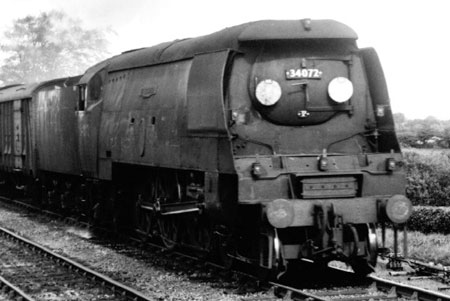 |
34072 257 Squadron, a 9 ft wide example, in the 1960s now attached to a narrow bodied 4,500 gallon tender, which was never cut-down |
The early members of the class, 21C100 – 21C148 (34001 – 34048) were named after locations in the West Country that were served by the Southern Railway. Later locomotives, 21C149 (34049) - 34090, were named to commemorate the Battle of Britain. The next 18 reverted to West Country names, 34091 – 34108. The last two, 34109 and 34110, were again named in the Battle of Britain theme.
Rebuilding
Following the conversion of some Merchant Navy locos the decision was taken to rebuild the Battle of Britain and West Country classes into more conventional locomotives. The approaching demise of Southern steam saw the rebuilding program halted at a point when 60 out of the 110 locos had been rebuilt.
The narrow cab members of the class had their cabs widened when rebuilt.
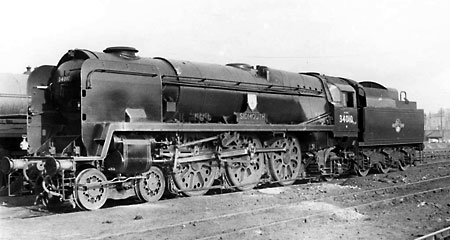 |
34010 Sidmouth as rebuilt, now attached to a wider cut-down 5,500 gallon tender. Seen here at Nine
Elms Shed |
One disadvantage of rebuilding was it resulted in a heavier locomotive, which barred them from some routes west of Exeter where a powerful loco was still required. This meant that the originals were still required for this area.
Our Light Pacifics
Of our locomotives 34010 Sidmouth, 34028 Eddystone, 34053 Sir Keith Park and 34058 Sir Frederick Pile were rebuilt, while 34070 Manston and 34072 257 Squadron were not.
Technical Details – Locomotives
| Original | Rebuilt | |||||||||||||||||||||||||||||||||||||||||||||||
|
|
Bulleid tenders
Please click here for the section on Bulleid tenders.